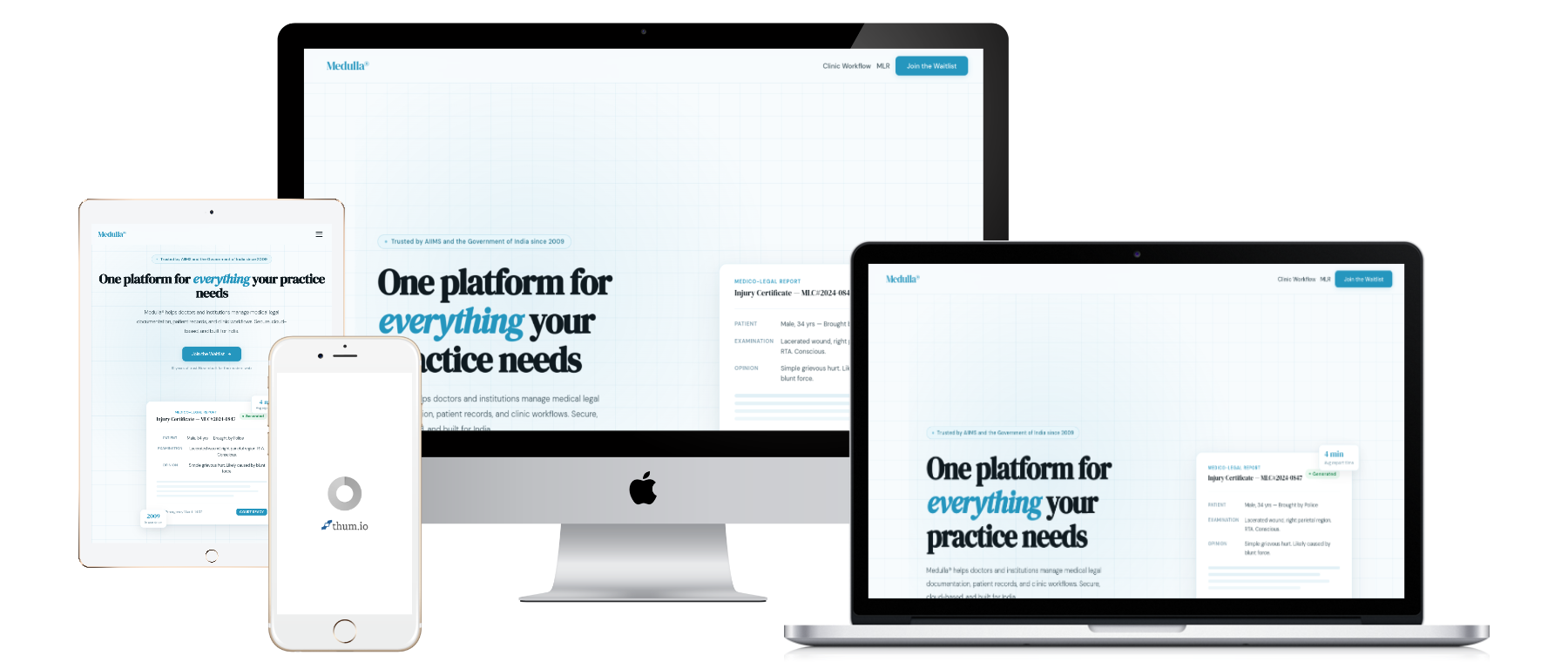
Medical Legal
Medulla
Rebuilt for the modern world
Key Results
Measured outcomes that matter
- Structured, consistent reporting for police/court/insurance usage
- Faster emergency documentation compared to handwriting
- Secure cloud storage with backups and reliability improvements
- Phased rollout preserving continuity for existing users
Starting Point
Where the workflow broke
Emergency wards run on speed and clarity. Doctors needed to produce multi-page medical legal documents that remain readable under pressure—while eliminating the inconsistencies and delays of handwritten reports.
End-to-end Ownership
Built through the full delivery loop
Initial Consulting
Deep-dived into the legacy platform to understand what clinicians loved, what they tolerated, and what the old architecture made impossible.
Product Research
Researched how doctors actually produce documents in emergency settings, prioritising speed and readability above all else.
Product Roadmap
Designed a phased rollout so the transition didn’t disrupt daily usage for teams that depend on the tool.
Tech Selection and Infrastructure
Selected Next.js and Django as the foundations and built cloud infrastructure for the reliability the domain requires.
Team Assembly
Assembled and led the delivery team across the full stack with aligned quality and timeline execution.
UI and UX Design
Redesigned the interface for web—preserving familiarity for existing users while improving speed and clarity in the ward.
Branding and Identity
Refreshed the Medulla identity for the relaunch while keeping the trust signals clinicians were already comfortable with.
Full Stack Development
Rebuilt the platform end-to-end with a microservices backend, designed to stay extensible for future document workflow changes.
User Interviews and Testing
Tested the rebuilt workflow with real doctors and iterated until document creation felt natural under emergency conditions.
Phased Deployment
Managed rollout in stages so existing users transitioned without friction, while the system improved incrementally.
What Makes It Different
AI-native where it matters
Web + cloud access
Moved from machine-locked desktop licensing to accessible web usage, enabling consistent access from the modern workflow environment.
Structured, readable outputs
A digital document workflow that produces consistent reporting for police, courts, and insurance review.
Secure storage and backups
Cloud hosting introduced secure storage, backups, and reliability that local-only systems couldn’t provide.
Phased continuity
The rebuild preserved continuity for teams already using the workflow daily.
Maintainable architecture
A modern microservices backend makes it easier to extend document types without breaking established workflows.
Our Process
Workflow-first. AI-native delivery.
Workflow audit (legacy to reality)
We start by understanding the legacy workflow deeply: where the tool saves time, where friction appears, and what must not change.
Document UX for speed
We design the UI around emergency pacing so doctors can produce structured documents quickly and confidently.
Rebuild with extensibility
We rebuild the system end-to-end with modern architecture, so future document workflow changes are safer and faster.
Real-user validation
We test with clinicians in realistic conditions and iterate until the workflow holds under pressure.
Phased rollout & adoption
We ship in phases, support teams through transition, and continuously reduce friction as adoption grows.
“Rebuilding something trusted since 2009 is not simple. Upkram took ownership of the full process and delivered a modern, reliable platform that keeps clinicians confident.”